
Thank you! Your submission has been received!
Oops! Something went wrong while submitting the form.
August 17, 2026
.png)
For more than a century, one person typing shorthand was the only way to make the record. That stopped being true in 1993, when Federal Rule of Civil Procedure (FRCP) 30(b)(3) was amended. Most litigators haven't had a reason to revisit the question since, but there is a compelling reason to do so now.
Stenographers are increasingly difficult to book, and the digital alternative has evolved considerably since the last time most attorneys evaluated it.
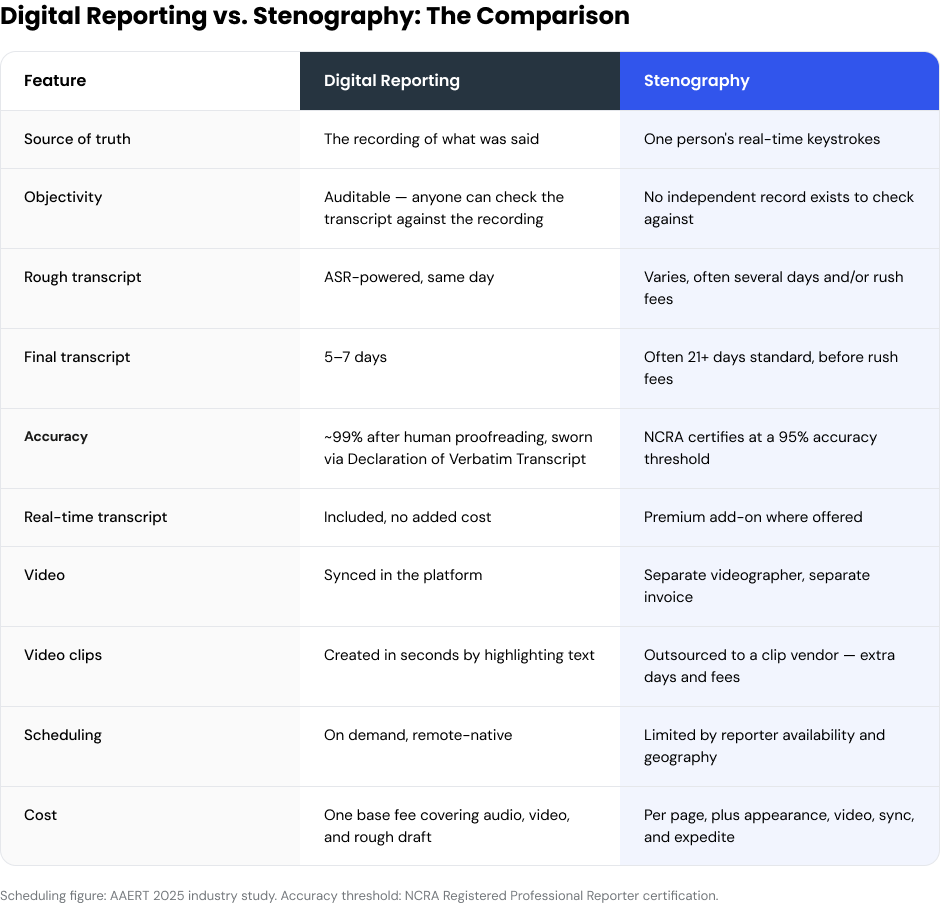
This article compares the two methods on the terms that decide a deposition: the record, accuracy, turnaround, and cost.
Stenography has been the standard method for making a verbatim legal record since the late nineteenth century, and it remains a demanding profession. A stenographer types shorthand on a stenotype machine in real time as the witness speaks, later producing the transcript from those notes.
The method's defining characteristic is also its constraint: the record relies entirely on one person's keystrokes. Unless a videographer is separately retained, there is no independent audio or video of the proceeding to check the transcript against.
The second issue is supply. In AAERT's 2025 industry study, 76% of end users reported difficulty scheduling traditional stenographers. The profession loses roughly 920 net reporters a year against an average age of almost 60.
%20(1).png)
Digital reporting captures a deposition with professional audio and video equipment instead of a stenotype machine. For a comprehensive overview, read our guide on What Is Digital Reporting. The short version follows below.
Where stenography produces a single asset, digital reporting produces three:
This is not an unattended recording; a trained digital reporter runs the proceeding from start to finish. As a certified notary, they swear in the witness, monitor audio and video quality in real time, and manage the room. They also annotate timestamps, log speakers, index exhibits, and troubleshoot technical issues before they affect the record. Furthermore, a backup recording runs continuously alongside the primary feed.
Many digital reporters hold AAERT certification. In April 2026, AAERT merged with STAR to form CAPTUR (the Council for the Advancement of Professionals, Technology, and Unbiased Reporting).
This is the first question every litigator asks.
Skribe's human-proofread final transcripts are approximately 99% accurate. The NCRA certifies stenographers at a 95% accuracy threshold. These figures are worth stating because they measure different things: one is a delivered rate, while the other is a certification floor.
However, the more useful point is not the number itself, but what backs it.
A digital transcript is entirely auditable. Every word in the final transcript is checked against the recording during production. A transcriptionist can replay a passage as many times as it takes to get it right. That is why digital transcripts often carry fewer "inaudible" notations, as a difficult exchange gets another listen instead of a placeholder. If a dispute arises later about what a witness said, the recording is there to settle it.
A stenographic transcript offers no equivalent. If the notes are wrong, nothing independent exists to reveal the error.
Skribe's final transcript is sworn accurate through a Declaration of Verbatim Transcript that accompanies it.
The courts have already weighed in on this. In Garza v. Energy Transfer Partners, depositions were taken using the Skribe platform. Opposing counsel was unsatisfied, hired a stenographer to re-transcribe the proceedings, and moved to tax the cost to the other side. The court denied the motion, holding that the re-transcription was an unnecessary duplication because the depositions had already been validly transcribed.
Yes, and it has been for over thirty years.
FRCP 30(b)(3) was amended in 1993 to permit testimony recorded by "audio, audiovisual, or stenographic means". This choice belongs solely to the noticing party. No court order is required, and no stipulation is needed.
Under FRCP 30(b)(3)(A), the noticing party simply states the recording method in the deposition notice. That is the entire procedure. The rules officially refer to the result as a non-stenographic deposition.
If opposing counsel objects, they may arrange for a stenographer at their own expense. However, they cannot stop a non-stenographic deposition from moving forward.
Digital reporting is admissible in nearly every U.S. jurisdiction. Requirements vary by state, which our state-by-state guide covers in detail.
Digital reporting is the stronger choice for most practices. It fits litigators taking depositions at volume, firms prioritizing cost predictability, and anyone who needs a same-day rough draft. It also serves practices that want testimony to remain a useful asset after the deposition ends. That is the fundamental job of a Deposition Intelligence Platform. Inside the Skribe platform, the record stays searchable, clip-ready, and reviewable rather than being filed away as a static PDF.
Stenography still applies in the small number of jurisdictions that strictly require it.
Outside of those specific states, the comparison is not especially close. Digital reporting produces a more complete record, delivers it faster, costs less, and can be objectively verified against the audio.
“Skribe outperforms traditional court reporting services because video provides a more accurate representation of what was said and the accompanying gestures, and using Skribe retains the benefits of having a transcript for reference and quick searches within the record. The availability of a deposition record within a few hours is far superior to waiting for weeks or longer for a stenographic transcript or edited video from a videographer.”
Kyle More, Tarek Fahmy Law
Digital reporting captures a deposition with professional audio and video equipment managed by a digital reporter. Stenography captures it as shorthand typed by a stenographer. The practical difference is that digital reporting leaves a verifiable recording, ensuring the transcript can be checked against exactly what was said.
Typically, yes. Digital reporting is quoted as one transparent base fee covering audio, video, and all the transcripts (i.e., realtime, same-day rough, and final). Stenography is billed per page, with appearance fees, video, video sync, and expedite charges added separately. See [transparent pricing] for details.
In most jurisdictions, no. Under FRCP 30(b)(3), the noticing party chooses the recording method and states it in the notice. Opposing counsel may retain a stenographer at their own expense, but they cannot prevent the deposition from proceeding non-stenographically.
Digital reporting is permissible in nearly every U.S. jurisdiction. Requirements vary by state, which our state-by-state guide covers in detail.
Skribe's human-proofread final transcripts are approximately 99% accurate and are sworn accurate through a Declaration of Verbatim Transcript. The NCRA certifies stenographers at a 95% accuracy threshold.
A live real-time feed runs during the deposition. An ASR-powered rough transcript, synced to video, is available the same day. The human-verified final transcript arrives in 5–7 days.
Many hold AAERT certification, which is now administered by CAPTUR following the April 2026 merger of AAERT and STAR. Digital reporters are also commissioned notaries, which empowers them to swear in witnesses.
The digital reporter monitors both audio and video throughout the proceeding, catching problems as they happen. A backup recording runs alongside the primary feed, ensuring a single technical failure does not put the record at risk. More details are available in the FAQ.
