
Thank you! Your submission has been received!
Oops! Something went wrong while submitting the form.
August 17, 2026
.png)
If you've tried to book a shorthand court reporter recently, you already know the problem: there aren't enough of them. The national shortage of stenographers means longer wait times, higher costs, and scheduling that revolves around reporter availability rather than case strategy.
Digital reporting, which is a non-stenographic method of capturing depositions, is how a growing number of firms are solving that problem without sacrificing transcript quality. But what is digital reporting?
This article will outline the digital reporting definition, explain how an ASR-powered rough transcript becomes available within hours, and share how to use digital reporting in compliance with FRCP 30(b)(3) and state equivalents.
Digital reporting is a non-stenographic method of capturing depositions and other legal proceedings. Instead of a stenotype machine, a digital reporter uses professional audio and video recording equipment to create the official record. The reporter manages the recording, swears in witnesses, and ensures a complete, high-quality capture of the proceeding. Many digital reporters are AAERT-certified and commissioned notaries, trained to similar professional standards as a stenographer.
That's the digital reporting definition, but practically, the key distinction is that it is a non-stenographic form of reporting. As a non-stenographic method, it provides three assets (instead of one):
Digital reporting, sometimes called electronic reporting or non-stenographic reporting (the term used in the Federal Rules), provides transcriptions quickly without sacrificing quality.
Many assume that non-stenographic reporting means a lower level of quality. Stenographers are highly trained and valued professionals. The reality is that digital reporters are also highly trained professionals.
It's important to remember that digital reporting does not get rid of the professional. In fact, it adds an extra layer of validity (audio and video recording) to the final transcription.
A digital court reporter does many of the same duties as a stenographer, including:
Swears in witnesses as a certified notary: many are certified and administer the oath the same way a stenographer does
Monitors audio and video quality: watches the recording in real time to ensure there are no technical difficulties, interference, or cross-talk that could create confusion
Annotates the transcription: creates timestamps, logs speakers, and outlines other contextual information
Manages exhibits: indexes exhibits as they are introduced
Maintains digital quality: ensures quality audio and video files are recorded
The most significant difference between a digital reporter and a stenographer is setting up and monitoring the audio and video equipment. Digital court reporters are trained to capture the highest audio quality, and they can quickly identify and troubleshoot technical issues.
An unmonitored recording is when someone records a legal proceeding, but there is no professional monitoring or watching the recording.
The recording could be very low quality, or a malfunction could cause the recording to stop partway through. With monitored digital reporting, a professional catches issues in real time and a backup recording runs alongside the primary. A digital reporter also swears in the witness.
Many digital reporters are certified by the AAERT (American Association of Electronic Reporters and Transcribers). The AAERT provides Certified Electronic Reporter (CER) and Certified Deposition Reporter (CDR).
In place of learning shorthand, these reporters learn about audio and video equipment and managing recordings. Otherwise, the training a digital reporter receives is very similar to a stenographer's. In fact, STAR (Society for the Technological Advancement of Reporting) recently merged with AAERT. The merger formed CAPTUR, The Council for the Advancement of Professionals, Technology, and Unbiased Reporting. This merger emphasizes that both types of reporters are held to the same high standards.
A final transcription is made by a professional transcriptionist. This final transcript is available within 5-7 days.
A transcriber referencing the full recording can replay any passage as many times as needed. Because of this, non-stenographic reporting often allows for a more complete, verbatim record.
Digital reporting may feel new, but it's been an approved method of capturing legal testimony for over three decades.
In 1993, the Federal Rule of Civil Procedure 30(b)(3) was amended so that testimony could be recorded by “audio, audiovisual, or stenographic means.”
FRCP 30(b)(3) — amended 1993
Testimony may be recorded by audio, audiovisual, or stenographic means.
Still, it has been questioned. In Garza v. Energy Transfer Partners (Skribe was the digital reporting platform used in the case), depositions were taken using digital reporting. The opposing counsel wasn't satisfied with this method, so they hired a stenographer. They then tried to pass the costs to the other party. The court denied the costs, ruling the re-transcription was an unnecessary duplication because the depositions had already been validly transcribed.
Read more about why the stenography costs were denied.
In federal court, the recording method, whether audio, audiovisual, or stenographic, needs to be stated by the noticing party. It is their choice, and no approval is needed. This is under FRCP 30(b)(3)(A).
Digital court reporting has been approved on a federal level, and most states have followed suit. You can find a complete guide to state-by-state admissibility of digital reporting here.
The only difference is the capture method. A digital reporter uses professional audio and video recording equipment instead of a stenography machine.
Digital reporters provide very similar professional supervision and accuracy as a stenographer in obtaining an official record of testimony.
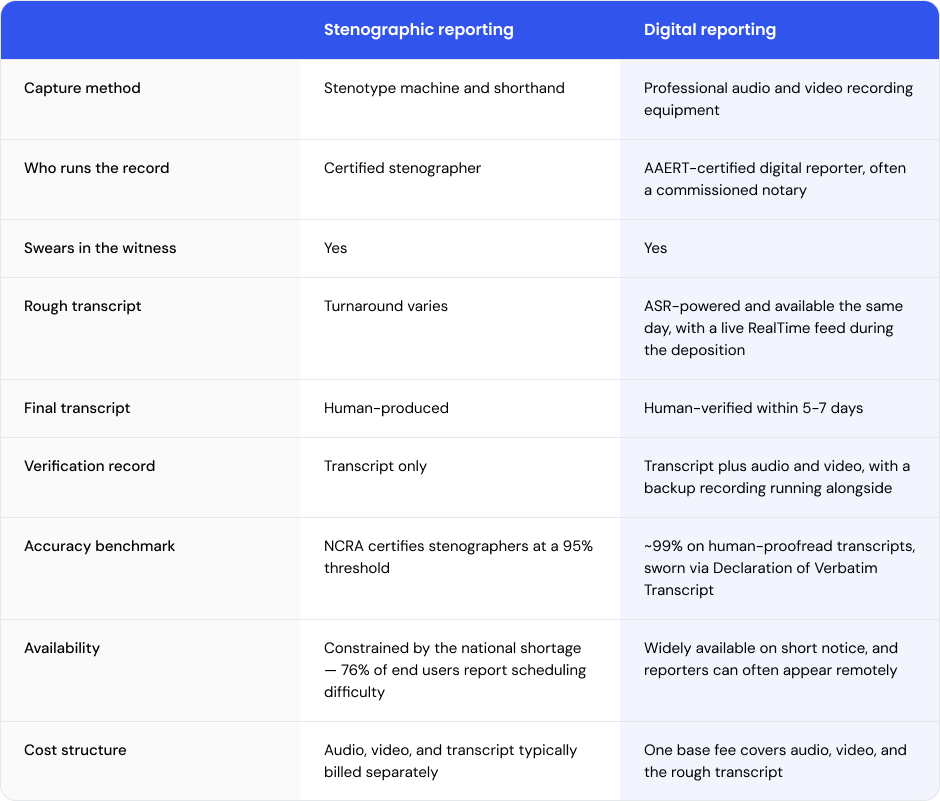
Scheduling figure: AAERT 2025 industry study. Accuracy threshold: NCRA Registered Professional Reporter certification.
Today, firms that use digital court reporting are able to move faster, and with lower overhead. These are some of the ways digital reporting provides greater value than stenography.
One of the most practical reasons for using digital reporting is that it is more widely available. In AAERT's 2025 industry study, 76% of end users reported scheduling difficulties when trying to find traditional stenographers. The solution is working with digital reporters, who are more common and easier to find on short notice.
This allows you to focus on the big picture, knowing digital reporting does not come with the same logistical hurdles as traditional reporting.
One of the biggest benefits to digital reporting is access to a rough transcript in less than a day. Demand letters, discovery follow-ups, and motion drafts can all move forward within hours of a deposition.
The ability to generate transcripts and videos quickly has significantly streamlined our operations, particularly when it comes to sending demands or following up on discovery. The same-day video delivery is a standout feature that enhances our efficiency.
Steven Sachs, Espinoza & Brock
Having a digital recording means that those difficult-to-decipher moments can be reviewed. That means fewer “inaudible” sections in transcripts. If there is a question about what was said, it can be reviewed.
Recordings preserve the testimony of key witnesses, even pre-lawsuit. Our firm routinely wins liability disputes by showing the adverse insurer a certified transcript and sworn video statement of what the eyewitness would say at trial.
Charlie Gustin, Gustin Law
When these recordings are winning disputes, digitally capturing sworn accurate statements can quickly become a best practice.
Digital reporting is an efficient process, providing audio, video, and reporting all in one.
And the cost is typically lower. A digital reporting base fee covers audio, video, and a rough draft transcript, whereas traditional stenography often charges separately for each of those services.
For many firms, improved efficiency at a lower price point makes it the obvious choice.
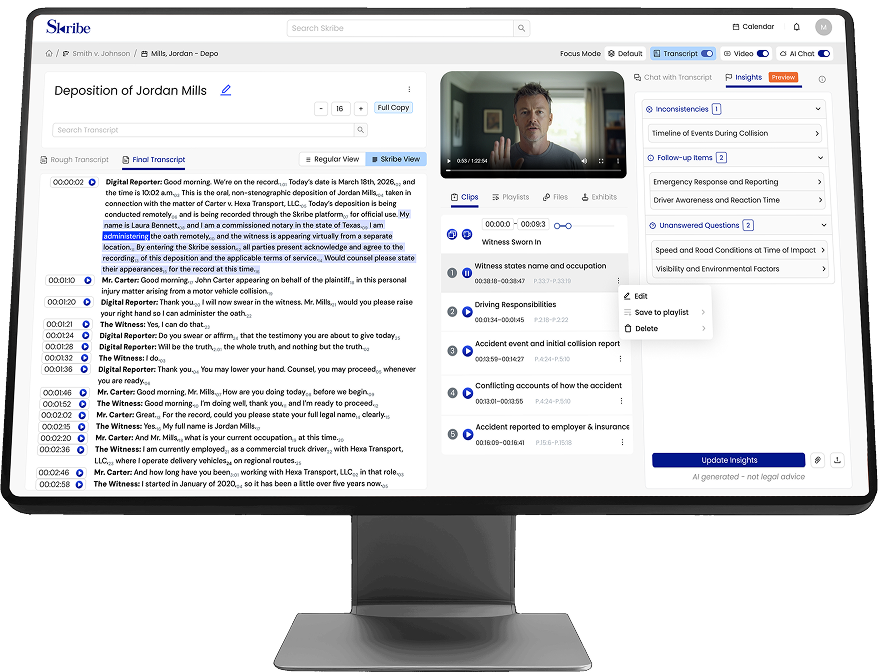
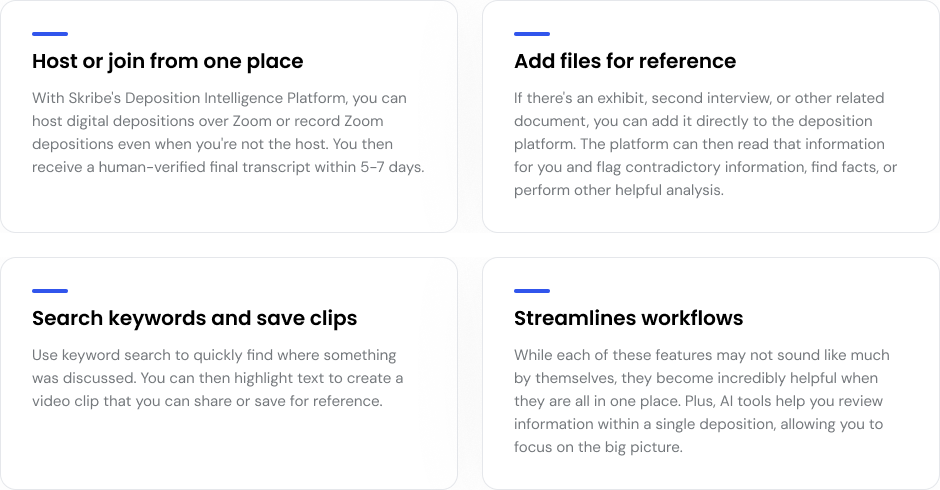
The Deposition Intelligence Platform helps you quickly find and verify information, whether it's finding a contradiction, checking testimony against an official record, or pulling a clip for mediation.
With all your transcriptions, video, and audio recordings in one place, Skribe's Deposition Intelligence Platform provides additional features that make finding information and connecting the dots painless.
Read more about adding documents to Skribe's Deposition Intelligence Platform.
Learn more about Skribe's Deposition Intelligence Platform.
The Skribe product is superior to traditional depositions. The presentation is superior and the costs are lower.
Justin Morley, Langley & Banack, Inc.
If you understand the digital reporting definition, and that it is a proven and legal method of producing human-verified final transcripts, then the biggest question is, why wait?
Non-stenographic depositions are only going to become more common. Don't be bottlenecked waiting for legal transcriptions.
Learn more about how Skribe can lower overhead while improving your workflows.
Digital reporting is a non-stenographic form of capturing legal testimony. A human, digital reporter manages professional audio and video equipment so that there is a recording of all proceedings. ASR software allows for same-day rough transcripts, and final human-verified transcripts are available within 5-7 days.
Yes. FRCP 30(b)(3) was amended in 1993 to allow deposition testimony to be recorded by audio, audiovisual, or stenographic means. Since then, most states have also allowed non-stenographic recording methods. The noticing party must state the recording method in the deposition notice. You can find a complete guide to state-by-state admissibility of digital reporting here.
Skribe's human-proofread transcripts are ~99% accurate. They are sworn accurate through a Declaration of Verbatim Transcript that accompanies the final transcript. For reference, the NCRA certifies stenographers at a 95% accuracy threshold.
Digital reporters monitor audio and video recordings, so they know when an issue or failure occurs. If someone loses a mic while talking, the reporter can ask them to repeat themselves once the mic is back on. There is also a backup recording running alongside the primary recording, creating two duplicate recordings in case one fails.
Digital reporters are certified notaries who swear in witnesses, just like a stenographer would.
A live RealTime feed is available during depositions. A complete ASR-powered rough transcript, synced with video, is available the same day as the proceeding. A final transcript is available within 5-7 days.
No. Digital reporters are highly trained individuals, and they perform several crucial roles, including operating and managing technical equipment, swearing in witnesses, and clarifying speech in real time.
Under FRCP 30(b)(3) and most state law equivalents, any party may designate a non-stenographic method of recording without needing agreement from other parties or leave of court. If opposing counsel objects, they may arrange for a stenographer at their own expense, but they cannot prevent a non-stenographic deposition from proceeding. Many attorneys find that once they experience the quality of the audio/video record and same-day rough draft, they prefer the digital format.
The national shortage of stenographic court reporters has made it increasingly difficult to schedule depositions, especially on short notice or in rural areas. Digital reporting solves this problem because digital reporters can cover proceedings using professional audio and video equipment, and in many cases can appear remotely. This means fewer postponements and more flexibility for your litigation calendar.
ASR technology used in digital reporting has reached accuracy levels that meet or exceed traditional stenography benchmarks. The NCRA's Registered Professional Reporter (RPR) certification requires 95% accuracy, while modern ASR engines routinely achieve higher rates on clear audio, even before the transcript is professionally proofread. Because digital reporting also captures a complete audio and video record, every word can be verified against the original recording during transcript production, adding a layer of quality assurance that stenography alone cannot provide.
